Thursday, April 14, 2016

We Could All Use a Day Off

After months of cold weather and cloudy skies it seems like spring may finally be upon us (fingers crossed.)  But as long awaited as this arrival was, the beautiful weather has a tendency to do the opposite of motivate us, which could prove dangerous as finals approach.  Suddenly the idea of basking in the sun on Old Main Lawn seems much more appealing than sitting in a classroom for a couple of hours.  Everyday seems to require a little more effort to get to class, making it safe to say that all we want is day off to just enjoy the sunshine.

In an attempt to cope with this daily internal struggle, it is appropriate to live vicariously through movie characters who have the luxury of taking a day off with no consequences.  John Hughes' 1986 film Ferris Bueller's Day Off is a perfect example of a film that allows us to do just this in classic 80's movie style.  Starring Matthew Broderick, this film is about exactly what its title suggests; high school senior Ferris Bueller decides that he simply needs a day off of school to enjoy an adventure with his friends.
Via Tumblr
After an elaborate plot to make his absence excusable, Ferris rounds up his best friend Cameron and girlfriend Sloane to take on the day in Chicago rather than deal with another monotonous day at school.  Throughout their day, the trio manage to see a baseball game, visit both the Sears Tower and the Art Institute of Chicago, sneak their way into a fancy restaurant, and even catch themselves in a flashmob parade.
Via Tumblr
Hughes keeps the plot simple by providing little conflict within the characters themselves.  Ferris has no qualms about skipping school as he has deemed it necessary to take a mental health day and sees any possible consequences as trivial.  The only one with an objection to the plan is Cameron, although Ferris is quick to establish Cameron as uptight and a prime example as to why a day off is so paramount in the first place.  The only force in opposition to the kids is the school principal and Ferris' sister, who are not fooled by the scheme.  As Ferris and his friends run around Chicago, a number of close encounters with those trying to stop them keep the film's action moving as the kids must avoid getting in trouble at all costs.

In its classic 80's romantic comedy style, the film is overly ideal in that the kids are able to get away with so much at little to no consequence.  While it is easy to see dismiss this as one of the movie's flaws, doing so would hinder the viewer from understanding the whole point Hughes was trying to make.  Ferris Bueller is not a movie that delves into its characters in order to discover something deeper about human nature.  It is simply a romantic comedy that exists to be lighthearted and funny. In doing so, the film gives an alternate reality in which to allow ourselves to take our day off without actually doing so.
Via Tumblr

Thursday, April 7, 2016

Getting Away From It All

Have you ever had a day where you thought about dropping everything, getting on a plane, and flying to a deserted island just to get away from all of your responsibilities?  We know that we cannot actually get away from them, but the thought of doing so is reassuring enough.

But what would happen if we had the courage to get away from these responsibilities?  Would it be for the better?  Or would the consequences ultimately be detrimental?  Sam Mendes' 1999 film American Beauty challenges this question through its protagonist, Lester Burnham (played by Kevin Spacey), and his willingness to separate himself from the things that burden him.
Via Tumblr
Lester lives as a stereotypical middle-aged-father and has become exhaustingly bored by the monotony.  He appears to live in a neat little world, with a loving wife and daughter, living in their perfect home, doing everything as they are supposed to.  The film's narration quickly puts an end to this idea, as Lester's thoughts tell us that he has grown to be cynical and annoyed by all of the elements of his life that define who he is.  He does not enjoy his job and cannot stand his boss.  While he loves his family, he cannot seem to connect with them.  His daughter acts as though she hates her father, and his wife barely pays attention to him, forcing Lester to fantasize instead about Jane's 16 year old friend Angela.

This crush motivates Lester into becoming a person that chases after his dreams rather than accepting the position he is in.  He starts to work out in an effort to impress her, in addition to buying a new sports car.  The transformation continues as a new family moves down the street consisting of Army Colonel Fitts, his wife, and their quiet, strange son Ricky.  As Jane and Ricky become involved, Jane is driven even further from her father, and Lester feels compelled to better himself.  He quits his job, much to his wife's disappointment, to pursue a job flipping burgers at the local drive-in.  While it seems that Lester's life has significantly gone downhill, he could not be happier that he is doing what he thinks is for the better.  In fact, he does so much for self betterment over the course of the film that he is completely unfazed by the discovering of his wife's affair.
Via Quotesgram
While this film's main character is laced with pessimism and cynicism regarding the suburbia he is trapped inside, his transformation, which begins with the creepy fantasies about his daughter's best friend changes his from subdued to driven.  This drive has Lester unafraid of doing what we all long to do:  drop everything and do something for ourselves for once.  Spacey's character becomes funny, brash, and driven (even if by the wrong thing), but is flawed in his reluctance to observe the affects of his actions on those around him.  Sure, he may be feeling better off for the changes he made, but not stopping to consider how the others might take it has deleterious consequences in the end.  This movie allows us to think about which we should value more:  pleasing those whom we are closest too, or doing whatever we deem right for ourselves.
Via Rebloggy

Thursday, March 31, 2016

Carpe Diem!

In a world in which we are reminded everyday of the importance of success, it becomes easy to feel consumed by pressure.  We want to impress our parents, make our teachers proud, and live up to the standards for which we hold ourselves, but often this pressure forces us to take action based on what we think we ought to do versus what we actually desire.  Our lives become routine, allowing us to forget that each day is an opportunity to achieve something great.

This idea of "Carpe Diem," or seizing the day, is the main tagline of Peter Weir's 1989 film Dead Poets Society.  Starring Robin Williams, this film offers countless ideas of how people can and should seek out opportunities that benefit their needs instead of trying to make others happy.  
Via Tumblr
At an all boys prep school bursting with future Ivy Leaguers, Williams plays eccentric English teacher Mr. John Keating, who appears in stark contrast to the rest of the teaching staff.  From the first day of school Keating proves that he is not like other teachers.  He whistles war tunes and recites poetry and is clearly not afraid to criticize scholarly works with which he does not agree.  Where the majority of other classes begin with a boring lecture followed by a lengthy assignment, Keating takes his students outside of the classroom to remind them that they have the power to change the world. 

Via Giphy
Keating's classes soon become popular, as they become a place where the boys are allowed to explore their individuality and creativity.  Keating encourages behavior from his students which is unacceptable in any other classroom.  He has them stand on desks, yell verses of poetry at the top of their lungs, and tear pages out of textbooks, all in the attempt to get the students to become comfortable with thinking for themselves.  As they develop a habit of this, the boys begin to explore their interests without worrying about parental approval.  

In addition to these attempts to seize the day, the boys start up an old club, The Dead Poets Society, which Keating himself was a part of back in high school.  The Dead Poets Society meetings, held in secret, allow the boys to recite poetry they find convincing, drink and smoke without fear of being caught, and hang out with girls.  As the meetings progress, so do the boys' desire to find and do something meaningful.  However, the rest of the staff do not appreciate the free thinkers Keating has created, and begin to enact consequences on both parties.

As the struggle between the school's authority and the students continues, the film forces us to think about the struggle it sometimes takes to be free thinking individuals.  The majority of Keating's scenes are convincing in that they make us as viewers want to take control and seize our own lives. 

What this film lacks in visual grandeur, it makes up for in dialogue and message, as Keating's prolific lessons instill in the audience not only the desire, but the necessity to find meaning within the world.   Dead Poets Society stresses the importance of thinking creatively and not letting the pressures of authority hinder any opportunity to seize the day. 

Thursday, March 24, 2016

Just How Good Are The Bad Guys?

As I explored in a previous post, gangster films have a way of captivating us because they depict a world so different than the lifestyle that everyday people live.  These films allow us to explore a world in which lying, gambling, stealing, and cheating are a natural way to obtain what everyone wants:  to live the high life.

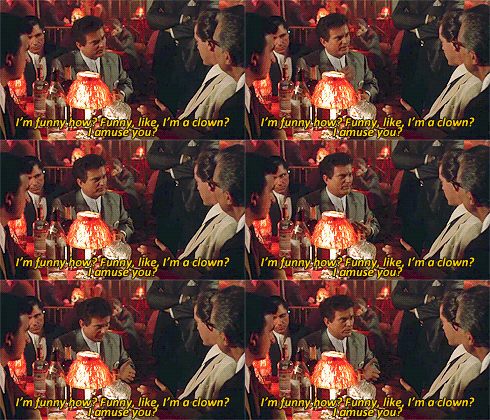
Martin Scorsese's 1990 film Goodfellas is one of the most iconic gangster films of the 20th century, falling short only to The Godfather.  Goodfellas gives us everything we need from a gangster movie including the action, the humor, and the deception that comes with thinking that this type of lifestyle is feasible to keep up.

Via Tumblr
The movie's protagonist, Henry Hill (Ray Liotta), has shared this captivation with a life in organized crime since his childhood, and as a teenager is taken under the wing of Jimmy Conway (Robert De Niro) and Paulie Cicero (Paul Sorvino).  From his first schemes selling stolen cigarettes, Henry learns more and more about the business of organized crime and begins to lure others into his lifestyle.  When Henry marries his fiance Karen, he opens the door to his undercover world, effectively employing her as a mob wife.  Karen too becomes comfortable with the lifestyle she and Henry are able to live, residing in a big house with the latest clothes and other luxuries, practically invincible to authority.

Through Henry's naivety, Scorsese creates an illusion of safety brought on by the mob world, fooling the characters and the audience into thinking that loyalty to the family is enough to keep everyone out of trouble.  In a way, this film glamorizes the mob by demonstrating the benefits to its members, while maintaining an air of greasy charm.
Via Tumblr
However the nature of the supporting characters serves as a reminder that most of these gangsters are simply hotheaded, impulsive criminals that do not use rational thinking for many of their actions.  In fact, one of Henry's best friends within the family, Tommy DeVito (Joe Pesci) ends up killing a man in a bar fight due to a petty insult.  This, in addition to the killings, robberies, and corruption keep the viewer's mind on the fact that the actions of the characters are by no means legal or ethical.  But they do make for good entertainment, loading the film with action to balance out the scenes depicting the mundane activities of everyday gangster life.

Via brostrick
The movie's characters allow us to analyze multiple sides of the mob, providing a balance between the allure of luxury and security and the price at which it is obtained.  Henry's wife shows signs of being scared of the trouble her new husband is a part of, but quickly realizes that the action and drama make for an exciting life.  Henry on the other hand cannot seem to find the problem with being involved with the "bad crowd" and Goodfellas shows us the toll this takes on both his professional relationships and his family's wellbeing.

Scorsese captures the essence of the film best in one of the last scenes in which Henry frantically tries to avoid a drug bust all the while making the family recipe for spaghetti sauce.  In this moment, the film achieves its goal of building up and breaking down the glamor associated with the gangster genre by giving us characters that fail time and time again to convince both themselves and the audience that they are acting for the greater good.


Thursday, March 17, 2016

Why So Serious?

Since their inception, superhero stories have generated passionate fans.  Not only does the action make for good entertainment, but the concept of a superhero is also reassuring to audiences.  The idea that someone could use special powers to bring about justice is comforting in that often we as normal citizens feel powerless in too many situations.

Christopher Nolan's 2008 film The Dark Knight, depicts Batman as a hero who although does not technically have superpowers, still has the means to bring about justice for the city of Gotham. Following Nolan's 2005 film Batman Begins, The Dark Knight picks up Batman's story as he must defeat the infamous Joker while maintaining his secret identity as Bruce Wayne.

Via Gif2Fly
However, the thing that makes The Dark Knight so appealing to viewers lies less in the idea of good conquering evil because let's face it—would you expect anything else from a superhero movie? Rather, this film puts a heavy focus on outlining the psychology behind good versus evil.  Although Batman's character means well, he, like any good hero, has plenty of flaws that make Bruce Wayne/Batman a complex character, especially as his city declares him a vigilante rather than the hero he is trying to be.  

Similarly, Harvey Dent, an acquaintance of Bruce Wayne's, displays this complexity through his actions as the District Attorney of Gotham.  Dent rises to fame as a hero as he rounds up many the notorious criminals that plague the city.  As Dent becomes known as a "White Knight" to the city, it appears that his sole purpose is enforcing justice.  However, this film shows the relative ease with which people change their motives.  In the case of Harvey Dent, the loss of his love interest, a burn across half his face, and an encounter with the Joker are enough to turn this once "White Knight" into the villain Two-Face who seeks revenge rather than justice.

Via Comic Book Movie
While characters like Batman and Two-Face are intriguing because of their complexity, easily the most interesting character of the film is the Joker.  From the beginning of the movie it is clear that the Joker does not play by the rules.  Right off the bat, this lends the film to an unpredictable character in opposition with our hero.  This unwillingness to play by anyone's rules other than his own creates a character that is both maniacal and clever, oddly demanding respect for this villain.  While the Joker is the obvious bad guy, it is hard not to be impressed with the amount of chaos he able to conjure up. The Joker plays countless mind games on the police, civilians, and even those who work for him, acting as though he makes things up as he goes, but proving that each move has been carefully thought out.

Via Tumblr
While the Joker's character alone is interesting enough, Heath Ledger does a brilliant portrayal, complete with the iconic maniacal laughter that accompanies many of his most intense scenes.  The Academy celebrated Ledger's performance by awarding him with the Oscar for Best Performance of an Actor in a Supporting Role posthumously.

The actions of the Joker allow The Dark Knight to put an emphasis on the psychology behind a supervillain in contrast to that of a superhero.  Interestingly enough, both parties are willing to take responsibility for the harm caused to their city, but for different reasons.  While the Joker thrives off the chaos, Batman recognizes that the people need someone to blame and is willing to be that figure if it means bringing justice in the end.

Tuesday, March 1, 2016

And the Oscar Goes To...

Unless you have been living under a rock, you have probably heard that Leonardo DiCaprio finally won a long awaited Oscar for Best Performance by an Actor in a Leading Role at Sunday's 88th Academy Awards.  Along with the rest of the Internet celebrating what seems like an award two decades overdue, it only seemed fair to dedicate this post to one of Leo's more powerful, yet lesser known films.

Scott Kalvert's The Basketball Diaries (1995) depicts DiCaprio as high school basketball star Jim
Carroll.  Based on the real Carroll's autobiography of the same name, The Basketball Diaries tells the story of Jim's fall from star player on an unbeatable team to heroine junkie living on the streets.

Jim, who attends a Catholic school in New York City, has the talent to make a career out of his sport after he graduates.  However, after Jim's best friend loses his battle with cancer, Jim spirals into depression that leads to drinking away the pain of such a loss.  Jim and his friends, including a boy named Mickey (played by Mark Wahlberg) simply view their coping as a way to have fun and also begin to dabble in drugs, eventually trying heroine.  Through the voice over narration, we see Jim's addiction growing stronger despite his claims that he could "stop anytime he wanted."
Via Tumblr
Eventually things spiral out of control; Jim stops going to school so he can get high and is kicked out of his home by a mother that refuses to support a junkie.  Life on the streets forces Jim to fend for himself by stealing, mugging, and even prostituting himself in order to avoid starving to death and allow him to feed his addiction.

The story takes a heart wrenching tole on the viewer, as Leo himself was only eighteen during the movie's filming.  Actually being as young as the character he is playing allows the audience to truly observe the loss of innocence that Jim's character experiences as he feeds his addiction through any means necessary.  In a heart breaking scene, we see Jim beg for his mother to forgive him, when in all actuality he only needs money to keep him out of trouble.


At this moment we remember just how young Jim actually is, and it seems both unfair and wrong that he allowed himself to be put in such a situation.  The movie sheds a light on the horrors of drug addiction, portrayed most effectively through DiCaprio's acting in which the authenticity brings such a powerful message to the screen.

Despite the lack of popularity that The Basketball Diaries earned versus many of DiCaprio's other films, in my opinion it is one of his most commendable performances because of the power behind it. As we see how pathetic Jim's actions become, we implore him to get clean so as to avoid the misery he keeps putting himself through.  DiCaprio's acting through these tough to watch scenes are what make the movie so effective, as it is obvious that he really is just a kid. This power leaves a lasting impression on the viewer, as it sheds light on the cruelties of the world, but also reminds us that there is always hope when the outlook is bleak.


Thursday, February 18, 2016

Getting Outside Our Element

Science is awesome.  Take the recent discovery of gravitational waves as an example.  Even if you are not a science person you can still take a moment to appreciate how cool it is that we have learned so much about our world and yet are still always learning new things.  This idea is what makes science fiction movies captivating to their audiences, as people cannot help but love learning new things.  However, for those of you that are not 100% into sci-fi does not mean that movies about science can't appeal to you.

Based on the novel by Andy Weir,  The Martian, directed by Ridley Scott (2015) is a perfect example of how movies can use science as an important part of the plot without going over our heads and totally geeking us out.  Unlike movies such as Christopher Nolan's Interstellar, The Martian does not rely on the audience's understanding of basic astrophysics and space-time.  Instead, this movie uses its scientific elements as a catalyst for the action without overloading the viewer with information.

The Martian portrays a team of scientists who have traveled to Mars to collect data for research.   After a disastrous storm, the team assumes that one of their men, a botanist named Mark Watney (played by Matt Damon), must have been killed, forcing them to leave his body behind so the rest of the team can return to Earth and complete the mission.  However, Watney survived the storm, leaving him stranded with only the supplies brought to Mars by previous missions and no means of return to Earth.  To stay alive, Watney must use his botanist skills and other scientific knowledge to survive long enough to be rescued.

Via Slant
The movie successfully appeases both our geeky side and the side that craves adventure, as we watch Watney's struggle to survive and his team's attempts to make a heroic rescue while the rest of Earth watches anxiously.  In his battle against the harsh Martian climate, Watney records daily journals to send to NASA, in which he incorporate humor and optimism that keep the film fun to watch, rather than purely a man-vs-nature story.
Via MTV
As the audience, we do not get bored of watching Watney's character meander around his shelter while he comes up with a plan, as the movie gives us a break from Watney to explore both the happenings aboard the spacecraft carrying the rest of Watney's team and those at NASA monitoring Watney.  This look into how the most important people of a highly regarded government agency handle such a tough situation also provides comic relief to the viewer, despite the severity of the consequences that could result from a wrong call.

The seriousness demanded by the action of the movie alongside the comic relief offered by a variety of characters make The Martian enjoyable to watch because we do not get tired out by the events. Likewise, the many fields of science exploited throughout the movie serve to not only keep us engaged as they hold the plot together, but also to inspire by commanding respect after seeing how useful and crucial knowledge can be.


Thursday, February 11, 2016

What Is So Captivating About Unrequited Love?

Do you believe in soulmates?  Is there such a thing as true love?  Is there such a thing as fate?  Do you believe in love at first sight?  

Whether we want to admit it or not, we have probably all either been asked or at least thought about these questions.  Our opinions about an idea as complex as love have likely adapted as we have experienced more of the world, and will continue to change as we get older.  With Valentine's Day only a few days away, these complicated questions seem to be haunting us at every corner.  So what better way to try and answer them than with a movie, in which we can experience another person's relationship without any of the heartbreak that is potentially to follow. 
Via Tumblr
Marc Webb's 2009 film (500) Days of Summer tackles many of these questions in classic romantic comedy fashion, with the twist of a non-chronological sequence of events.  The movie takes the classic "boy meets girl" story and writes it so the audience gets to see attitudes about love that cover the spectrum from cynical to overly optimistic.  The movie tells the story of Tom, played by Joseph Gordon-Levitt, and Summer, played by Zooey Deschanel.  In a sentence, the hour and a half long film could be summarized by saying that Tom falls for the beautiful and enigmatic Summer, who fails to love Tom back.  Of course, this would be a horrible generalization, as the importance of the movie lies not in who ends up with whom, but how the characters deal with their feelings.

Tom's character, who writes slogans for greeting cards, falls head-over-heels for a girl he believes to be out of his league.  And she is.  But not for some ethereal beauty, or overwhelming popularity, but because Summer seems to be playing a different game.  While his infatuation leads to wanting a long term relationship, Summer seeks out a causal fling.  The two are unable to agree what love really is and how to appease it, causing them to argue often.  

Via Tumblr
vs.
Via Pinterest
After many fights over the definition of their relationship and what the future holds, the couple eventually grow apart, leading the characters in opposite directions.  Tom goes spiraling into depression, while Summer is more than happy to be on her own.  However, as time progresses, it seems that both Summer and Tom were somewhat wrong about their individual approach to love, allowing them to validate the other's actions.  

When the two reunite down the road, they are able to see that their actions obviously had a greater impact on the other's perception of the world than they could have imagined.  The movie forces us to realize that regardless the outcome, relationships have a way of changing our minds because we must learn from other people to make them successful.  Tom is able to become less naive, while Summer is able to be more open with her heart.  This movie makes for the perfect Valentine's Day story because it leaves us on a happy note, even if it is not necessarily the ending we wanted.  It also incorporates humor, a cute story, and an incredible soundtrack, making it the perfect movie for any time of the year.  
Via The Odyssey

Thursday, February 4, 2016

Rules Are Made to be Broken

A common theme throughout this blog is the importance of a good plot.  Good plots keep us engaged by giving us enough information to know what is going on, but constantly keeping us asking questions, making inferences, and paying close attention to see if we were right.  The best plots are the ones that blow our minds when we reach the end of the movie.

David Fincher's 1999 film Fight Club is one of those movies that has you questioning the events throughout the duration of the movie, but when we reach the end, leaves us amazed at how seamlessly all of the events came together.  Fight Club is one of the most frequently quoted movies of the 90s—think about it... even if you have not seen this movie, you still probably know the first rule of fight club—but the reason these lines became so iconic in the first place is because of their context.
Via The Odyssey 
The film portrays a man (played by Edward Norton) who narrates the mundane events of his life as a product recall specialist.  Right off the bat, we see that there is something off about this character, as his insomnia and inability to cope with his frustration regarding consumerism lead to his attendance of a multitude of support groups for diseases he does not have.

One day while on a flight for business, the narrator encounters a man called Tyler Durden (played by Brad Pitt) with whom he is immediately intrigued by.  Meeting up after the flight, Tyler and the narrator engage in a strange conversation in which Tyler demands the narrator hit him as hard as he can, eventually leading to the two getting into a fight.  However, the experience is more about the satisfaction of hitting someone than the pain of being hit back, so the pair begin a fighting group for men to alleviate some of their stress.  This eventually grows into Fight Club, a selective, underground group led by Tyler and motivated by his avant garde theories on life.

Via Tumblr
As his participation in Fight Club allows the narrator to break out of the monotony, we as the viewers begin to notice strange similarities between the narrator and Tyler, until finally the action brings us back to where the movie began and we remember that we have been watching a flashback. Everything makes sense at this point, but it does not happen until the final scene of the movie.

So why wait so long to tie everything together?

The beauty of a bookended plot is that it forces us to go back in our minds and recall details from the beginning of the film that seemed negligible at first, but now make sense as to why the director decided to include them.  In Fight Club, these details include things like the narrator's insomnia and the coincidences which brought the narrator and Tyler together.  When the final scene brings all these details together, the audience is able to have the same epiphany that the narrator has without having been in the loop already.  The careful crafting in the plot and the thought-provoking statements often rattled off by Tyler make this film a cult classic that will not get old no matter how many times you have seen it.

Thursday, January 28, 2016

Saving the War Story

Recently in my Theatre 100 class, our professor posed the question "What is a story?"  His thought, short and to the point, was that stories are simply what happens in the story.  Movies also allow us to answer this question as we observe the characters and interpret their stories.  There are funny stories, love stories, scary stories, etc., but one genre people tend to forget about are the war stories.  In the Vietnam War novel The Things They Carried author Tim O'Brien writes: 

“A true war story is never moral. It does not instruct, nor encourage virtue, nor suggest models of proper human behavior, nor restrain men from doing the things men have always done. If a story seems moral, do not believe it. If at the end of a war story you feel uplifted, or if you feel that some small bit of rectitude has been salvaged from the larger waste, then you have been made the victim of a very old and terrible lie. There is no rectitude whatsoever. There is no virtue. As a first rule of thumb, therefore, you can tell a true war story by its absolute and uncompromising allegiance to obscenity and evil. "

That is not to say that all aspects of a war story are obscene or evil, just that they are a crucial part of the whole.  While there have been plenty of movies that incorporate a plot about war, Steven Spielberg's 1998 film Saving Private Ryan wholeheartedly encompasses the essence of the war story.
Via Quotesville
Saving Private Ryan features Army Captain John Miller (played by Tom Hanks) as he leads his men through WWII, following the storming of the beaches at Normandy.  Miller and his squad are given the mission of finding a young man called Private Ryan (played by Matt Damon) so he can be sent home in order to ease the heartache of Ryan's mother, whose three eldest sons have already perished in the war.  

As Miller and his men traipse across France in search of Ryan, the movie analyzes both the physical obstacles and emotional challenges they face.  Throughout their journey, the men must fight their way through enemy territory, leading unsurprisingly to casualties among the squad.  The more obstacles they endure, the more the team begins to question the validity of their mission; what is the point of risking a group of people to bring one guy back?  Miller attempts to qualm these fears, but internally feels the toll of war as well.  Predictably, the men become bitter with their task, demonstrating the demoralizing nature of war.  This is particularly evident in a scene in which the men are instructed to search a pile of dog tags in case Ryan may already be dead.  Rifling through the tags, the men forget the fact that the friends of the soldiers whom the tags belong are watching strangers turn their friends' deaths into a rowdy poker match, trading for tags and yelling "Full House."


The war itself seems to almost play its own character, as it is exploited through Miller's journey.  The idea that a true war story does not serve the purpose of being uplifting is evident throughout this film, as we see our characters doubt themselves and question whether the sacrifices they are making are truly worth it.  We see the transformation war has on all characters, as even the captain feels himself growing farther from his identity with every growing minute spent overseas.  Spielberg, who won the Academy Award for Best Director for this film, was able to successfully portray these transformations by not sugarcoating the war.  He tells us what we already know, but do not necessarily want to be reminded of:  war is violent, everyone cannot make it home alive, and even the most level headed men can lose their grip. 

Saving Private Ryan marries these elements of violence and loss with those of brotherhood and love to create a solid war story.  The film is able to leave you feeling satisfied with the ending, but torn with a greater understanding of the cost of war. 

If this has not convinced you that this movie can be enjoyed over and over, I think it is relevant to note that it also won four other Academy Awards in technical categories, implying that both the plot and the hard footage were well crafted.  


Thursday, November 19, 2015

Get Busy Watching

You never know where you are going to meet someone that will eventually turn into a good friend.  It could be in class, or at a club, or just by a random conversation one day, but the point is friends come to us often when we are not expecting it.  Sometimes we are even more surprised by the actual person, as we get to know them and realize how wrong our initial judgements may have been.  Frank Darabont's 1994 film The Shawshank Redemption (based on the novel by Stephen King) proves this, as fellow inmates of Shawshank Prison become close friends despite an unusual set of circumstances.

The Shawshank Redemption tells the story of two men, "Red" Redding (played by Morgan Freeman) and Andy Dufresne (played by Tim Robbins), who are both prisoners inside Shawshank Prison, convicted of murder.  While Red jokingly claims that he himself may be "the only guilty man in Shawshank," Andy was actually wrongfully convicted, forcing him to a lifetime sentence for no reason.
Via Random Enthusiam
Andy, an educated man who was a banker before his conviction, knows he does not belong in Shawshank, making him withdrawn from his fellow inmates.  His isolation from the rest of the prison community and status as a new inmate makes him a target that spends his first few years enduring brutal beatings and harassment.  However, from his very first night in Shawshank, Red had taken an interest in Andy the moment he proved himself mentally stronger than anyone initially thought by not being the first to break down.

The pair have their first real interaction when Andy approaches Red with a request for a small hammer, as Red is known as the man that can get things.  The series of requests that follow spark Red's interest, and he slowly begins to get to know Andy, who in return begins to become more outgoing around Red and the other inmates.  As Andy gains more attention, he is given the opportunity to put his education and financial experience to use, teaching the other inmates, doing the guards taxes, and eventually getting involved in a money laundering scheme for the warden.  All of this occurs slowly over the course of several years, as time in prison moves pretty slow when you know you will be there for the rest of your life.

*SPOILER ALERT* One day after about two decades in Shawshank, Andy is nowhere to be found.  It is discovered that he has become the first person to escape Shawshank, conveniently around the time Red's parole is soon to be up.  By this point, Red is undoubtably Andy's best friend and the reason he does not succumb to the anxiety created by being an innocent man imprisoned.  Red is finally able to successfully get out on parole and is left with the mystery of where Andy could be. Unlike many films, the movie provides the viewer with closure, ending on a hopeful note as the final frame concludes with Andy and Red hugging each other on a beach in Mexico, having both finally made it to freedom.

While this film vividly portrays the brutality and misery that come with prison life, it also succeeds in highlighting the importance of good friends and remaining hopeful in tough situations.  Although Andy knows he is an innocent man, he struggles to feel purposeful.  However, with Red's support, Andy begins to show his personality through a variety of schemes that spice up the monotony of prison life, providing the viewer with a balanced amount of both intensity and lightheartedness. Despite this monotony that comes with years of living the same routine day after day, the film itself is anything but boring.  In addition to the plot, the film also teases out the juxtaposition between the institutionalizing of the inmates and the hope that they must hold onto in order to avoid losing themselves.  It is these moments that truly allow the viewer to recognize the mental and emotional toil caused by being locked up, as seen through the heartbreaking suicide of the prison's beloved librarian, Brooks, who is unable to adjust to life on the outside after spending fifty years in Shawshank.
Via Movie Fan Central

Andy and Red prove that the only way to avoid such a fate is through reliance on friends in order to maintain hope and stay true to oneself.  Or as is commonly quoted throughout the movie, "get busy living, or get busy dying."  It is perhaps for these reasons that Shawshank is the highest rated movie on IMDb, making it seemingly one of the most popular films of all time.

Via Giphy


Tuesday, November 3, 2015

If Only It Was As Simple As Bad Guys vs. Good Guys

I am not sure what it is, but something is forever enticing about the gangster genre of film.  Whether it is a director's ability to evoke a certain level of fear and respect associated with the mob or to get viewers to justify the violence their favorite characters execute, the gangster genre is somehow always able to get the viewer to blur the line of what is right and wrong.  Maybe it is this confusion that pulls viewers into these films, or just the thrill of a life that carries such high stakes all the time.

Martin Scorsese's four time Oscar winning film The Departed (2006) portrays the gangster genre a little differently than other mob classics, giving the point of view of both law enforcement and those involved in organized crime.  Showing both sides allows Scorsese to confuse viewers with which side they should be rooting for.  The film takes the story of two men with similar upbringing but drastically different goals in their adult lives who cross paths through their involvement in organized crime.  Leonardo DiCaprio's character, Billy Costigan, has tried to cut the ties between himself and his family, who has has a history of organized crime, by joining the Boston Police Academy.  Meanwhile, Colin Sullivan, played by Matt Damon, has also entered the police academy the same year as Billy with a seemingly spotless reputation.  However, Sullivan has also been involved in organized crime since his youth, after being taken under the wing of Jack Nicholson's character, mobster Frank Costello (loosely based off real life gangster Whitey Bulger).

Via Tumblr
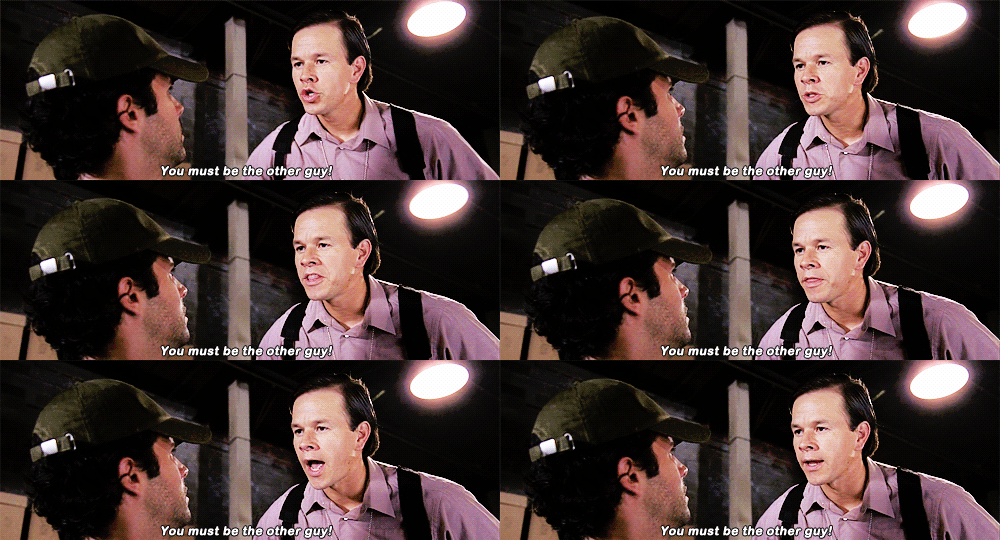
This begins to shade the gray area of good guys and bad guys as Costigan, whose intentions of joining law enforcement were to clear his name and conscience of his family's reputation, is told that he will never make a good police officer because of his history.  However, Staff Sergeant Dignam, played by Mark Wahlberg, tells Costigan that his best bet of helping the department is by going undercover and taking down mobster Costello from the inside.  On the other hand, Sullivan has been instructed by Costello, his mentor and boss, to enter law enforcement in order to keep tabs on the investigation surrounding the take down of Costello himself.
Via Giphy
In other words, we have a bad guy pretending to be a good guy and a good guy pretending to be a bad guy.

It is no surprise that the double lives led by Costigan and Sullivan lead to the development of relationships that exploit the classifications of bad versus good.  While the audience knows each characters' purpose, we begin to question these classifications as we see DiCaprio's character badly beat up Costello's rivals while Damon's character shows his soft side as he falls for his therapist. There is growing tension throughout the film as both the mob and the police department discover a mole among them.  The tension is aided by the fact that both moles have become so intertwined with their double lives that it seems unlikely they will ever return to their original selves, made even easier by the fact that next to no one knows of the infiltrations to both Costello's mob and the police department.
Via Giphy 
The film successfully blurs the line of right and wrong, allowing viewers to see the corruption on both sides, and the accompanying internal strife.  As any gangster film insists, The Departed is loaded with action and suspense as Costigan and Sullivan draw closer to discovering one another (which seems inevitable as Billy has access to police knowledge and Costello's crew, while Colin leads the investigation surrounding Costello).  The undercover work on both parts demands the plot rely on lies and betrayals, emphasizing the corruption found in every corner of the city.  Portraying the gangster genre through the eyes of nervous men who must constantly be watching their backs produces a film that puts the audience through the same level of intensity, making it enticing to watch over and over.

Wednesday, October 28, 2015

Oh, the Power of Memory

We all have memories we would rather not think about, and maybe even a few we wish we could forget.  But what are the consequences of forgetting certain things?  Is it really possible to just live life without these painful or embarrassing moments and still be the same person we are today?  Or are we shaped to be the person we are because of our experiences, whether they be good or bad?

Michel Gondry's 2004 movie Eternal Sunshine of the Spotless Mind explores this idea by creating a world in which memories can be targeted and erased at a person's request.  The film features a couple, Joel and Clementine (played by Jim Carrey and Kate Winslet), who have ended their long term relationship years ago.  However, Joel runs into Clementine one rainy morning only to discover that she has taken the liberty of having the memory of their relationship erased.  Already on emotionally on edge, Joel decides the best course of action is to request the same procedure be done on himself, so as to forget the emotional turmoil the sting of painful memories causes.
Via WiffleGif
Most of the film uniquely takes place inside of Joel's mind as he undergoes the procedure.  His mind is made into an environment in which we can see Joels's memories and simultaneously hear his thoughts reverberating inside his head.   As the procedure begins, we see how Joel's tendency to be emotionally withdrawn conflicted with the passion possessed by free-spirit Clementine, ultimately leading to the end of the relationship.  The memories are erased in reverse order and as Joel gets to the earlier stages of the relationship, both he and the movie's viewers begin to see that maybe the pair were not so bad for each other after all.  As the erasing progresses, Joel regrets his decision, focussing all of his mental energy trying to regain consciousness so as to end the procedure and keep the memories of an important part of his life that should not be forgotten.
Via WiffleGif
While the film operates mostly inside of Joel's head, there is also a parallel storyline happening in real time, in which the doctors performing the procedure.  It turns out these characters have as much drama in their lives as Joel and Clementine, having also undergone the procedure themselves.  (Note: The transition between settings may confuse viewers, similarly one of my earlier posts discussing how the story changes of Pulp Fiction could be confusing for viewers watching for the first time. Click here to read more.)

Eternal Sunshine begs the question of what the consequences of forgetting an experience, a time, or a person entirely will be.  Looking at Joel's regret of his decision, it becomes obvious that memories are what craft the people we are today.  Joel realizes this as he tries so desperately to cling to his past as it is being taken from him.  The film shows us that when we lose an experience, a time, or even a person from our memories we lose the parts of ourselves that these experiences helped to shape. While the plot revolves around a couple, it is not the romance between the two that the Oscar winning screenwriters of this film were aiming to convey.  Rather was the idea that while you can try to get rid of a negative experience, doing so would change who you are, and not necessary for the good.

I am also a sucker for movies that say their title in the film.

Wednesday, October 21, 2015

To the Movie Theater... And Beyond!

So far in this blog I have only discussed live action movies, but I felt like it was time to touch upon a movie that probably has a special place in most of our hearts:  Toy Story.

I don't doubt that a majority of you have seen Toy Story, as the films of the series all came out during the prime of our childhood.  How many of you at one point dressed up like Buzz Lightyear for Halloween, professing at the top of your lungs "to infinity and beyond!"?  How many ran around the house repeating the lines "you've got a friend in me," because those were the only words of the film's theme we could remember?  How many became convinced that this movie was proof that our toys were alive, leaving us determined to catch them in action?
Courtesy of Disney Pixar / Via giphy.com
While we can probably agree that Toy Story played an important role in our childhood, it is equally important to understand its significance on the animated movie industry.  When Toy Story came out in 1995, it was both Pixar's and the world's first full length movie that was created entirely by computer animation.  This obviously changed Pixar and the way animated movies were made, paving the way for those that followed such as Finding Nemo, Monsters Inc., and The Incredibles.  The animated movie industry was revolutionized with the introduction of the technology used to create Toy Story, allowing its influence to reach beyond the audiences for which the movie itself was intended.

For more information feel free to check out this article. 

However, this is not the reason it remains special to us as we have gotten older.  Throughout the series' fifteen year span since creation, Toy Story has been a series that we have literally grown up with.  It may have been one of the first movies you watched as a kid, and I can bet many of you anxiously awaited the premiere of Toy Story 3 in 2010 as much as I did.  For us, Toy Story was ours. We felt like it was created for us, and for the most part, it was.  The timing was too perfect; the reign of the first and second movies occurred during the point in our lives when all we did was play with toys.  The eleven year hiatus between the second and third movie was representative of the time we spent forgetting about our toys and started growing up.  When Toy Story 3 finally hit the big screen, we understood Andy's thoughts and actions about moving on from childhood because it would soon be time for us to do the same.  Movie makers allowed Andy to grow up at the same rate that the original movie's audience would grow up to ensure that the series would always be ours.
Courtesy of Disney Pixar / Via giphy.com

Collectively the series is synonymous with childhood and growing up.  Individually, each film depicts a fun, creative story that 90's kids, or kids of any era for that matter, would find both funny and heartwarming.  Not only that, but these films depict one of the strongest cases of the importance of friendship and loyalty to both kids now and the young adults that grew up with them.  Woody and Buzz have become a timeless example of friends that would do anything for one another.  Woody showed us the importance of loyalty with his refusal to give up on Andy.  Even minor characters taught us countless lessons, like Rex's portrayal of the importance of confidence.  Toy Story has crept its way into our hearts, growing in meaning each time as we watch these lessons play out in real life and understand how important they actually are.

Not to mention the snarky lines prevalent throughout the series that only get funnier with each viewing.
Courtesy of Disney Pixar / Via giphy.com

Thursday, October 15, 2015

Say Anything... (Say You Love This Movie)

Oh the allure of the 80's rom-com.

What is it about a movie made thirty years ago that somehow seems to appeal better to us than the modern romantic comedies we see today?  Maybe their reputations are hyped up and we feel obligated to like them.  Maybe they just feel more natural.  Maybe there is just something about 80's culture that seems fun, making us wish we could have been a part of it.  Maybe they are just well crafted movies.


Whatever the case, Cameron Crowe's 1989 film Say Anything captures the essence of an 80's romantic comedy, bringing out the hopeless romantic in all of us.

Some might say it's full of cliches, it's too picture perfect, things like that only happen in the movies. And it's true.  But that is half of the appeal of a romantic comedy.  We as humans love to strive for perfection, making it only right that we can appreciate it, even in fictional form.

Say Anything tells your classic boy-meets-girl love story that we hate to love (but love anyway). Basically you have underachiever Lloyd Dobler (played by John Cusack) and the top of the class, seemingly perfect Diane Court (played by Ione Skye), who fall for each other the summer after their high school graduation. Having just been there ourselves, many of us can relate all too well with the confusion that comes with moving on to the next chapter in our lives.  Diane wants to go to Europe on a scholarship to study.  Lloyd considers becoming a professional kick-boxer.

Despite their inability to be any different regarding their goals for the future, Lloyd and Diane seem to make the perfect match.  Lloyd himself is charming, passionate, and shares Diane's key characteristic of being a hard worker, although he lacks her certainty on how his life will pan out after school.  This lack of certainty is something everyone has felt at one point in their lives, connecting us indefinitely with the characters of the movie.

Like many romantic comedies, these minor character differences, alongside parental interference, spark conflict in an otherwise seemingly perfect relationship.  But a movie does not exist without conflict, and what is a movie centered around love without a couple of good arguments and *sigh* breakup scenes.

But have no fear, for as I have already stated, the reason we love these movies so much is because they create an atmosphere of almost-too-good-to-be-true, meaning we know they will come full circle.  For Say Anything, this happens in one of the most iconic moments in romantic comedy history: when Lloyd stands outside of Diane's window holding a boombox over his head in an effort to demonstrate how much he cares about her.


The captivation from this movie stems from Lloyd's character, as we find him effortlessly charming, witty, and down to earth in a way that can't help but break your heart when his own heart breaks. While Diane is a sweet girl with the best intentions at heart, it is Lloyd that audiences route for, as it is easy to see ourselves in him.  For the most part he is just your average kid that doesn't have a clue what direction he wants to take his life.  His charm is what keeps the viewer passionate about the relationship because we truly think Lloyd deserves happiness.

Say Anything takes us through the ups and downs of a young and fun relationship, having us "aw" at the sweet moments, laugh at goofiness of Lloyd, cry when we sympathize with the characters' heartbreak, and eventually feel like such a relationship is possible.  Say Anything depicts the romantic comedy in a way that feels natural and relatable, giving it that timeless allure that is characteristic of an 80's rom com.

Wednesday, October 7, 2015

Why We Should Pay Attention to Characterization

Characters matter.

This pretty much goes without saying, but in the case of Gus Van Sant's 1997 film Good Will Hunting, characters and character development are crucial elements that make this such an important movie.  Please note that dedicating this post to just one topic was particularly difficult, as I could probably ramble for hours about the multitude of things I love about it (the humor, the dialogue, the Boston accents.)

Ultimately, the characters are the thing that tie all of these elements together, while also being the platform through which the writers and the director were able to get their messages across.

Good Will Hunting tells the story of a young man named Will Hunting, played by Matt Damon, trying to find his place in this world.  Although he is incredibly smart (a certified genius actually), Will pretends he is content with both his job as a janitor at MIT and his slew of unstable relationships.  When it is discovered that Will is able to solve the complex math problems intended for the graduate students at MIT, the math professor offers to get Will out of a spot of trouble with a catch:  that he must study math alongside the professor, and see a therapist to sort out his apparent emotional issues.
Image courtesy of becausefilm.tumblr.com
Will's therapist, played by the late Robin Williams, acts as a contrasting figure to Damon's character. Will appears to the audience to be extraordinarily clever, but lacking ambition; extremely stubborn, but lost and confused; a guy who gets in bar fights for no reason, but cares deeply about his friends and loves passionately.  On the other hand, Sean Maguire (Williams' character) appears to be cool, calm, and collected, as he tolerates snarky comments and excessive stubbornness exhibited by Will in their first couple of sessions (some of which consist of an hour of silence simply for Will to make a point.)

Williams won a well deserved Oscar in the category for Best Supporting
Actor for his role as Sean in Good Will Hunting. 
However, we all have a breaking point, and thankfully so because it leads to the delivery my personal favorite monologue of the film.


From this point on, we see the growing of a more trusting relationship between Sean and Will, as Will is finally able to open up about his demons and look to Sean for advice regarding choosing a direction to take his life in.  This is where character development comes into play as we finally see Will question his life decisions and look to improve himself.

Why is Will able to change his perception of his world and his life?  Because not only did he have someone that was willing to listen to his problems, but someone that was willing to open themself up as well, proving that the relationship was not one sided.  It is the bond between these two that make the movie worth watching, as it touches our hearts to see both exercise their demons through one another.
Image courtesy of butlercat.tumblr.com 
Don't get me wrong.  Sean is still the superior of the pair, as he is the one constantly trying to coax information and emotions out of his patient, but he does not hesitate to show Will his own vulnerable side.  In a heart wrenching scene, we see the true measure in which the two trust one another, allowing us to sympathize with the relationship, and perhaps cherish the people in our own lives that support us like Sean and Will do.
Images courtesy of turkeyglue.tumblr.com
Before I wrap up, I want to warn you not to blow this movie off as an emotional film that is too serious when you just want to sit down and enjoy a lighthearted film.  While there are definitely a few emotional moments, the film is laced with humor and wit demonstrated by Will in about 90% of the movie.  Damon and co-writer Ben Affleck were able to balance out the deeper scenes with their playful banter, making it obvious why they won the Academy Award for Best Screenplay Written Directly for the Screen.  In short, this movie can make you laugh, it can make you cry, and it is definitely worth seeing more than once.