Wednesday, October 21, 2015

To the Movie Theater... And Beyond!

So far in this blog I have only discussed live action movies, but I felt like it was time to touch upon a movie that probably has a special place in most of our hearts:  Toy Story.

I don't doubt that a majority of you have seen Toy Story, as the films of the series all came out during the prime of our childhood.  How many of you at one point dressed up like Buzz Lightyear for Halloween, professing at the top of your lungs "to infinity and beyond!"?  How many ran around the house repeating the lines "you've got a friend in me," because those were the only words of the film's theme we could remember?  How many became convinced that this movie was proof that our toys were alive, leaving us determined to catch them in action?
Courtesy of Disney Pixar / Via giphy.com
While we can probably agree that Toy Story played an important role in our childhood, it is equally important to understand its significance on the animated movie industry.  When Toy Story came out in 1995, it was both Pixar's and the world's first full length movie that was created entirely by computer animation.  This obviously changed Pixar and the way animated movies were made, paving the way for those that followed such as Finding Nemo, Monsters Inc., and The Incredibles.  The animated movie industry was revolutionized with the introduction of the technology used to create Toy Story, allowing its influence to reach beyond the audiences for which the movie itself was intended.

For more information feel free to check out this article. 

However, this is not the reason it remains special to us as we have gotten older.  Throughout the series' fifteen year span since creation, Toy Story has been a series that we have literally grown up with.  It may have been one of the first movies you watched as a kid, and I can bet many of you anxiously awaited the premiere of Toy Story 3 in 2010 as much as I did.  For us, Toy Story was ours. We felt like it was created for us, and for the most part, it was.  The timing was too perfect; the reign of the first and second movies occurred during the point in our lives when all we did was play with toys.  The eleven year hiatus between the second and third movie was representative of the time we spent forgetting about our toys and started growing up.  When Toy Story 3 finally hit the big screen, we understood Andy's thoughts and actions about moving on from childhood because it would soon be time for us to do the same.  Movie makers allowed Andy to grow up at the same rate that the original movie's audience would grow up to ensure that the series would always be ours.
Courtesy of Disney Pixar / Via giphy.com

Collectively the series is synonymous with childhood and growing up.  Individually, each film depicts a fun, creative story that 90's kids, or kids of any era for that matter, would find both funny and heartwarming.  Not only that, but these films depict one of the strongest cases of the importance of friendship and loyalty to both kids now and the young adults that grew up with them.  Woody and Buzz have become a timeless example of friends that would do anything for one another.  Woody showed us the importance of loyalty with his refusal to give up on Andy.  Even minor characters taught us countless lessons, like Rex's portrayal of the importance of confidence.  Toy Story has crept its way into our hearts, growing in meaning each time as we watch these lessons play out in real life and understand how important they actually are.

Not to mention the snarky lines prevalent throughout the series that only get funnier with each viewing.
Courtesy of Disney Pixar / Via giphy.com

Thursday, October 15, 2015

Say Anything... (Say You Love This Movie)

Oh the allure of the 80's rom-com.

What is it about a movie made thirty years ago that somehow seems to appeal better to us than the modern romantic comedies we see today?  Maybe their reputations are hyped up and we feel obligated to like them.  Maybe they just feel more natural.  Maybe there is just something about 80's culture that seems fun, making us wish we could have been a part of it.  Maybe they are just well crafted movies.


Whatever the case, Cameron Crowe's 1989 film Say Anything captures the essence of an 80's romantic comedy, bringing out the hopeless romantic in all of us.

Some might say it's full of cliches, it's too picture perfect, things like that only happen in the movies. And it's true.  But that is half of the appeal of a romantic comedy.  We as humans love to strive for perfection, making it only right that we can appreciate it, even in fictional form.

Say Anything tells your classic boy-meets-girl love story that we hate to love (but love anyway). Basically you have underachiever Lloyd Dobler (played by John Cusack) and the top of the class, seemingly perfect Diane Court (played by Ione Skye), who fall for each other the summer after their high school graduation. Having just been there ourselves, many of us can relate all too well with the confusion that comes with moving on to the next chapter in our lives.  Diane wants to go to Europe on a scholarship to study.  Lloyd considers becoming a professional kick-boxer.

Despite their inability to be any different regarding their goals for the future, Lloyd and Diane seem to make the perfect match.  Lloyd himself is charming, passionate, and shares Diane's key characteristic of being a hard worker, although he lacks her certainty on how his life will pan out after school.  This lack of certainty is something everyone has felt at one point in their lives, connecting us indefinitely with the characters of the movie.

Like many romantic comedies, these minor character differences, alongside parental interference, spark conflict in an otherwise seemingly perfect relationship.  But a movie does not exist without conflict, and what is a movie centered around love without a couple of good arguments and *sigh* breakup scenes.

But have no fear, for as I have already stated, the reason we love these movies so much is because they create an atmosphere of almost-too-good-to-be-true, meaning we know they will come full circle.  For Say Anything, this happens in one of the most iconic moments in romantic comedy history: when Lloyd stands outside of Diane's window holding a boombox over his head in an effort to demonstrate how much he cares about her.


The captivation from this movie stems from Lloyd's character, as we find him effortlessly charming, witty, and down to earth in a way that can't help but break your heart when his own heart breaks. While Diane is a sweet girl with the best intentions at heart, it is Lloyd that audiences route for, as it is easy to see ourselves in him.  For the most part he is just your average kid that doesn't have a clue what direction he wants to take his life.  His charm is what keeps the viewer passionate about the relationship because we truly think Lloyd deserves happiness.

Say Anything takes us through the ups and downs of a young and fun relationship, having us "aw" at the sweet moments, laugh at goofiness of Lloyd, cry when we sympathize with the characters' heartbreak, and eventually feel like such a relationship is possible.  Say Anything depicts the romantic comedy in a way that feels natural and relatable, giving it that timeless allure that is characteristic of an 80's rom com.

Wednesday, October 7, 2015

Why We Should Pay Attention to Characterization

Characters matter.

This pretty much goes without saying, but in the case of Gus Van Sant's 1997 film Good Will Hunting, characters and character development are crucial elements that make this such an important movie.  Please note that dedicating this post to just one topic was particularly difficult, as I could probably ramble for hours about the multitude of things I love about it (the humor, the dialogue, the Boston accents.)

Ultimately, the characters are the thing that tie all of these elements together, while also being the platform through which the writers and the director were able to get their messages across.

Good Will Hunting tells the story of a young man named Will Hunting, played by Matt Damon, trying to find his place in this world.  Although he is incredibly smart (a certified genius actually), Will pretends he is content with both his job as a janitor at MIT and his slew of unstable relationships.  When it is discovered that Will is able to solve the complex math problems intended for the graduate students at MIT, the math professor offers to get Will out of a spot of trouble with a catch:  that he must study math alongside the professor, and see a therapist to sort out his apparent emotional issues.
Image courtesy of becausefilm.tumblr.com
Will's therapist, played by the late Robin Williams, acts as a contrasting figure to Damon's character. Will appears to the audience to be extraordinarily clever, but lacking ambition; extremely stubborn, but lost and confused; a guy who gets in bar fights for no reason, but cares deeply about his friends and loves passionately.  On the other hand, Sean Maguire (Williams' character) appears to be cool, calm, and collected, as he tolerates snarky comments and excessive stubbornness exhibited by Will in their first couple of sessions (some of which consist of an hour of silence simply for Will to make a point.)

Williams won a well deserved Oscar in the category for Best Supporting
Actor for his role as Sean in Good Will Hunting. 
However, we all have a breaking point, and thankfully so because it leads to the delivery my personal favorite monologue of the film.


From this point on, we see the growing of a more trusting relationship between Sean and Will, as Will is finally able to open up about his demons and look to Sean for advice regarding choosing a direction to take his life in.  This is where character development comes into play as we finally see Will question his life decisions and look to improve himself.

Why is Will able to change his perception of his world and his life?  Because not only did he have someone that was willing to listen to his problems, but someone that was willing to open themself up as well, proving that the relationship was not one sided.  It is the bond between these two that make the movie worth watching, as it touches our hearts to see both exercise their demons through one another.
Image courtesy of butlercat.tumblr.com 
Don't get me wrong.  Sean is still the superior of the pair, as he is the one constantly trying to coax information and emotions out of his patient, but he does not hesitate to show Will his own vulnerable side.  In a heart wrenching scene, we see the true measure in which the two trust one another, allowing us to sympathize with the relationship, and perhaps cherish the people in our own lives that support us like Sean and Will do.
Images courtesy of turkeyglue.tumblr.com
Before I wrap up, I want to warn you not to blow this movie off as an emotional film that is too serious when you just want to sit down and enjoy a lighthearted film.  While there are definitely a few emotional moments, the film is laced with humor and wit demonstrated by Will in about 90% of the movie.  Damon and co-writer Ben Affleck were able to balance out the deeper scenes with their playful banter, making it obvious why they won the Academy Award for Best Screenplay Written Directly for the Screen.  In short, this movie can make you laugh, it can make you cry, and it is definitely worth seeing more than once.

Thursday, October 1, 2015

The Power of Science and a Good Plot

Have you ever looked up at the sky and considered for a second the vastness of the universe we live in?  It's kind of overwhelming and frankly something I try to avoid when I'm not in the mood to have an existential crisis.

The recent discovery of liquid water on Mars is what inspired this week's movie. Christopher Nolan's 2014 film Interstellar prompts that feeling of crushing insignificance and the reminder of just how small one individual is in comparison to the universe surrounding us.

Does this make you nervous?  Don't worry, the main take away from this film is the power one individual can have if they exercise enough persistence.  That, and just how awesome science truly is. (Seriously, a lot of thought and research went into making this movie as scientifically accurate as possible.)

Disclaimer:  Many spoilers below because the understanding the plot of the film is crucial to understanding what makes it an important film.
Source 
The film depicts a family living in the future during a time when Earth's ability to support mankind is on a rapid decline.  Cooper, the father, (played by Matthew McConaughey) takes up a mission to explore the possibility of an Earth-like planet that may exist in an alternate plane of space, which can only be accessed by wormhole.  Cooper leaves his family on the mission when his children are young in order to search of a better future for them.  However, the crossing through wormholes leads to the introduction of time as a fourth dimension.  As the expedition travels further through space, time fluctuates dramatically, causing the team to age exponentially slower than those on Earth.  The concept of time as a fourth dimension is crucial to the plot of the film and what gives it so much depth.

Although the film is action packed as the characters encounter their fair share of challenges that come with space travel, it is the idea of love for family and friends that motivates the characters to keep pursuing their goal.  Time is their most prevalent enemy.  Cooper is in space long enough to miss the birth of his grandchildren after his son grows up while Cooper has aged only a few months in the same period.  In fact, he misses the entirety of his children's lives, due to the space-time warp across the wormholes.

Realizing how much a father would sacrifice for his family is not a new concept in movies. However, watching a grown man cry is something always touches the heart.  In fact this is the scene that made me tear up while watching this movie in theaters, and it still continues to be the most heartbreaking part of the movie no matter how many times you watch it.


These moments are what we find the most relatable because we can connect to them emotionally. However, while this film permeates deeper and touches our emotions, it is a rare case where the true beauty of the film lies in the plot.  To avoid too many spoilers I won't elaborate too much, but if you have seen the movie you were hopefully just as surprised and satisfied with the plot twist that bookends the entire movie.  In the case of Interstellar, plot is the most important aspect that keeps us watching over and over.  Nolan creates an unforgettable story as our minds are truly blown and we recall the immensity of the universe we live in.

This reflection is brought out solely through plot, because the deeper concepts of love and sacrifice are what relate to us on a small scale.  It is when we are watching the characters fly through blackholes and landing on planets no longer in our solar system that we gain a better understanding of how small we are as just one person on Earth.  This feeling evokes an internal reflection (whether good or bad is up to you) that leaves us thinking about the movie long after we have finished watching it.  And that makes us want to watch it more and have our minds blown again.


Thursday, September 24, 2015

There's Nothing Quite Like Childhood Friends

As I'm writing this on a Tuesday morning, clouds are taking over the sky and a light rain seems imminent.  In other words, it is the perfect movie weather.  In fact, all I want to do is curl up with a hot cup of coffee and a feel-good movie.

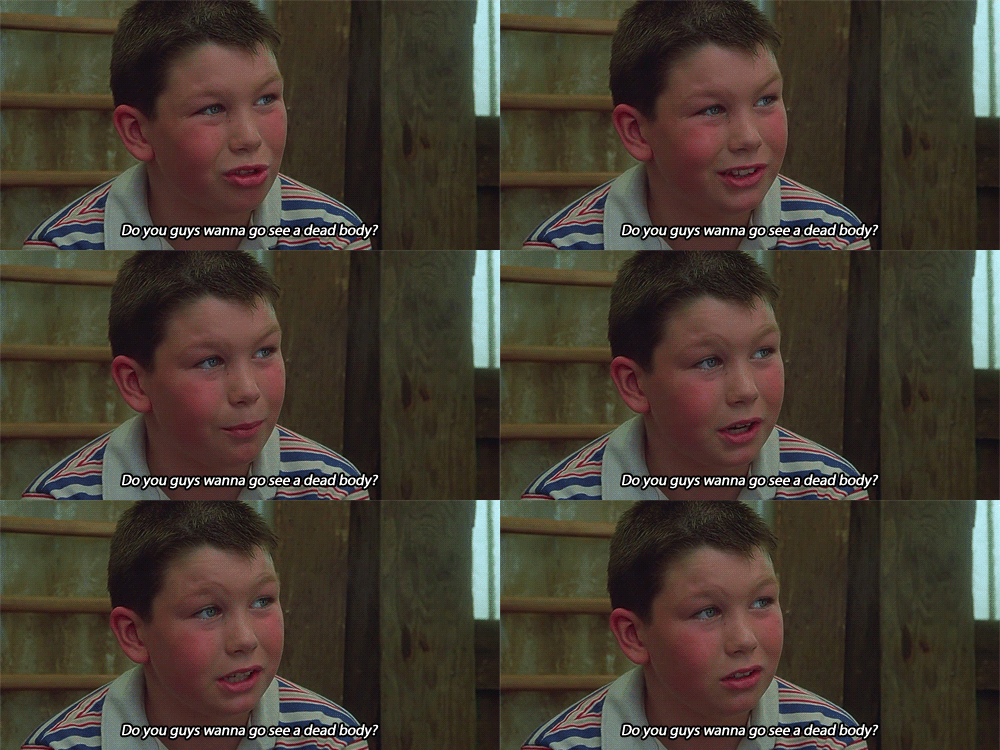
Rob Reiner's 1986 film, Stand By Me, is the perfect remedy to a day like today.

Stand By Me tells the story of a group of four twelve year old boys who go exploring to find the corpse of a boy who is reported to have died along the town's train tracks.  Based off the Stephen King novel The Body, you may expect this tale to be disturbing or scary, but do not be alarmed; the main take aways are regarding the importance of loyalty and friendship as we grow out of childhood and are forced to face reality.


The story is told through the eyes of the adult Gordie Lachance (played by Wil Wheaton) as he writes about his childhood and the weekend that changed his life.  Not many people can recall the exact moment they entered adulthood, but for Gordie, staring into the lifeless eyes of a kid his own age was this pivotal moment.

This point of view is crucial to creating the nostalgia that is present throughout the movie, while also bringing into light the looming idea of adulthood.  The narrator looks back on these moments spent horsing around with his friends as some of his best memories, making the movie not only funny, but just fun to watch, as it reminds us of our own memories.  Whether it be teasing each other (all in good fun of course), telling ghost stories around a bonfire, or acting tough to impress one another, Stand By Me brings us back to being kids when all we wanted to do was have a good time goofing off with our friends.  Moments like this are what make this a feel-good movie, as we watch this group of friends embracing being young and stupid.


However this film appeals to us as we know too well what it feels like to be at childhood's gate.  We watch the characters deal with issues such as dysfunctional family dynamics, bad reputations, death, and parental pressure to succeed, and even if we can't relate directly, we understand that with growing up comes the recognition that there are bigger issues than who would win in a foot race.


Why does this make the perfect movie for a rainy day?  Because it is laced with nostalgia, making us feel like everything is as simple as it used to be.  Not to mention a well crafted plot that keeps us laughing as we watch "boys just being boys", while also dying to know if they will find the body (pun intended).  It is heartbreaking at times, but comes with the important reminder that friends are what get us through the challenges we face, especially as we grow up.

I leave you with my favorite line, which is not even spoken, that drives home the idea of how important friends can be in shaping our lives.  The reason you will be captivated by this movie enough to watch it over and over is because it instills this idea, leaving us longing for a day to sit around goofing off with each other like we used to do.


Tuesday, September 15, 2015

The Breakfast Club (Spoiler: Not About Pancakes)

I want to preface this by saying I love John Hughes' movies.  Iconic dialogue and dynamic characters seem to be critical in making a classic 80's movie.

Among these classic 80's movies is Hughes' 1985 film The Breakfast Club.  You've probably noticed it playing on ABC Family every other weekend, but for good reason.  The Breakfast Club has stayed relevant for the past thirty years simply because both teenagers in the 80's and teenagers now are able to relate to the coming-of-age theme prevalent throughout the movie.

The Breakfast Club focuses on five students that must attend a Saturday detention for various reasons.  Although the students do not know each other personally (with one exception), they have for the most part, seen or heard of one another.  However, during the course of detention the characters seize (however reluctantly) the opportunity to get to know the others, breaking the labels they feel define them.  The film takes place over the course of just several hours, shot mostly in the library where detention is held.

The main take away from the film is that people are more then what they are labeled as.  The closing scene captures this idea perfectly with the voice over of the reading of a manuscript left by the students for the principal to read after detention ends.  The kids aver that "you see us as you want to see us," but refute with the understanding that people are too complex to be labeled as just one thing.

Our characters come into detention labeled individually as "a brain, an athlete, a basketcase, a princess, and a criminal."  If you have not seen the movie, or even if you have, take a second to create a visual of what our characters look like, what they act like, who their friends are, etc. We as humans try to be efficient in our personality classifications of one another, but the point Hughes is trying to make is that these classifications are often left in the primitive stages; we do not bother digging further to find out more about one another, missing out on what people are actually like.
Fun Fact: This scene in the library was not scripted, John Hughes
simply told the cast to act as their characters would. 
The exploitation of this idea is what makes this movie worth watching over and over.  Despite taking place in only a couple of hours, there is still character development, exemplified as we watch the characters take on aspects of each other.  Judd Nelson's character (the criminal) shows his soft side.  Molly Ringwald's character (the princess) insists that her life is not as picture perfect as she wants everyone to think.  Emilio Estevez's character (the athlete) appears on the verge of tears due to the pressure put on him by his father.

I digress.
The benefit of knowing the end result for the characters is watching what steps they must take to get there.  As a young adult I am always willing to receive advice on how to do the whole "growing up" thing.  In just the course of a day, the characters of The Breakfast Club show us the importance of connecting with people beyond a first impression.

Why is this lesson so important that we should soak it up over and over?

Because people are lazy and making connections with other people takes effort.  However, this movie proves to us that the effort may be worth it, as you would be surprised what people are like when you remove their labels.

Not to mention the final frame of Judd Nelson's fist clenched in the air as Don't You Forget About Me plays in the background, which gives me chills every time.


Friday, September 11, 2015

Getting Over the Timeline

I think it is safe to say that for the most part, people enjoy watching movies.  In the duration of a film, we laugh, we cry, we scream, or we sigh as we experience a variety of emotions.

Basically, we react.

We react to the plot, to the dialogue, to the characters, to all parts of the film so meticulously crafted by the director.  But reactions are unpredictable, meaning that the way we react to something once is not necessarily how we will react the second time around.

I am a firm believer that it is important, if not crucial, to watch movies again and again to experience the different reactions each viewing brings.


Quentin Tarantino's Pulp Fiction (1994) is a film that evokes a different reaction each viewing.  The movie depicts the lives of four individuals whose paths cross at various points in time.  The film is shot out of chronological order, introducing first a couple planning their robbery of a restaurant they are eating at.  At the height of the action of this robbery, the film stops to introduce two hitmen on an assignment.  After completing the job, one of the hitman, Vincent Vega (played by John Travolta), takes his boss's wife, Mia Wallace (played by Uma Thurman), on a date.  Next the film proceeds to introduce another set of characters: a boxer named Butch (played by Bruce Willis) and he and his girlfriend's escapades after Willis' character kills his opponent in the ring.

(Obviously there is a lot of action between these changes in scene, but I don't want to give away too many spoilers.)

These events are presented as chapters, indicating that it is not the big picture that matters, rather the individual stories themselves.  It is up to the viewer to put the puzzle pieces together, a task we are often too lazy to do and instead deem the movie "too confusing."

To the lazy viewers, note that I agree with you.  The transitions between chapters are as confusing as they sound when watching the movie for the first time.  The effort involved trying to keep up with the plot itself leaves little room to pick up on the details that make it such an engaging film.

But after watching the movie for a second, or even third time, we are no longer forced to focus so much on the confusion that erupts from the lack of sequence.  Instead we notice things such as the character growth demonstrated by Jules, as he decides he wants to quit his life as a gangster. Similarly, we are able to understand the symbolism of Mia and Vincent's date in a diner based off 50's pop culture.

Perhaps most entertainingly, we pick up the stylistics elements that only a Tarantino film can have, whether that be the exaggerated violence (because is it really a Tarantino movie if there isn't blood and guts galore), the classic worm's eye view shot, or even Tarantino's own cameo.
Fun Fact: Director Quentin Tarantino has been known to use this shot in most of his movies.

All of the things that distinguish Pulp Fiction are easily lost as we attempt to place all the scenes on a timeline.  However, after watching the movie more than once, we pick up on the little details that make this film what it is:  funny, riveting, and even insightful about human emotions and behavior.